
Equal Risk Investing
Risk parity investing, just as it sounds, is equal risk investing. Often times when investors refer to how their portfolio is invested they are referring to dollars not risk. The common example of this is a portfolio that is 60% stocks and 40% bonds. Most typically, that refers to 60% and 40% of the dollars in the portfolio. As we’ll show later, a portfolio like this does not provide anywhere near the risk diversification one might expect. We have developed the Better-Balanced Portfolio as a more effective solution.
There are four basic investment environments as shown below in Figure 1. They are: rising economic growth, falling economic growth, rising inflation, and falling inflation. All asset classes (stocks, bonds, gold, commodities, etc.) perform well in some of these environments, but no single asset class performs well in all investment environments.
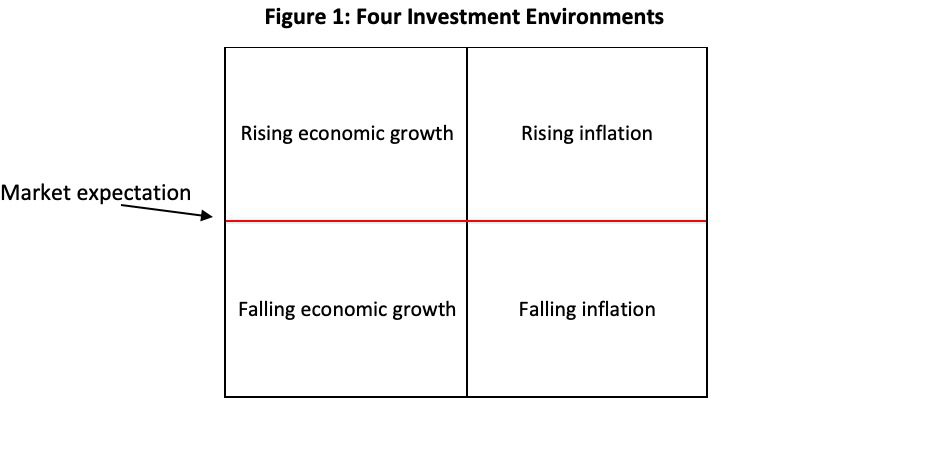
As one might expect, stocks perform well in two of the four environments – rising economic growth and falling inflation. A portfolio that is 100% stocks should do well in those periods, but will likely not do well in periods of falling economic growth or rising inflation. By allocating the risk in a portfolio equally among all of these environments, we create a portfolio that can likely perform better when stocks are not performing well.
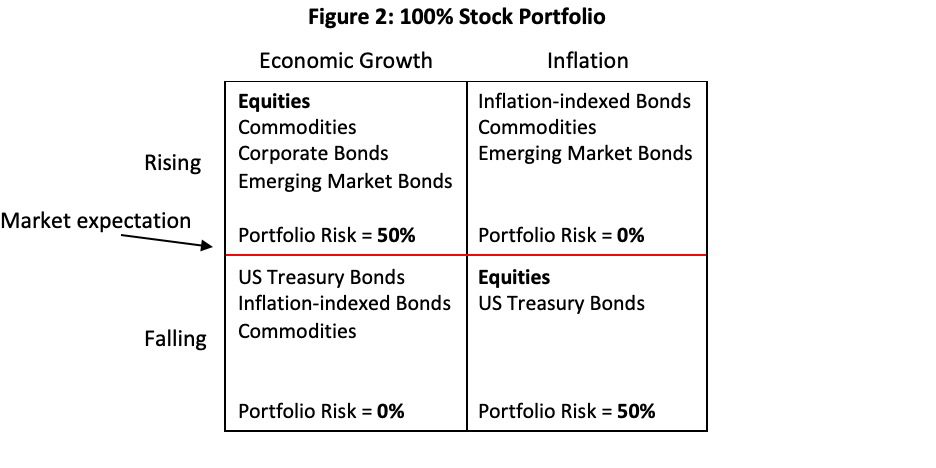
Figure 2 below shows how the risk in a 100% stock portfolio is allocated. While this portfolio should do well in the environments mentioned above with half of the risk in rising economic growth and the other half in falling inflation, it has no exposure to periods of falling economic growth and rising inflation.
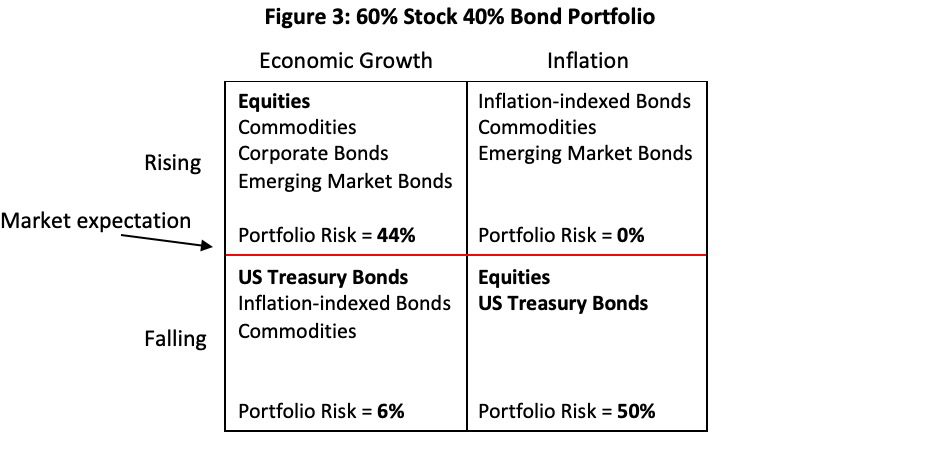
Similarly, and as alluded to earlier, a portfolio that is allocated 60% stocks and 40% bonds, based on dollars, shifts the risk much less than one might expect as shown below in Figure 3. Just 6% of the risk shifts from rising economic growth to falling economic growth. Generally speaking, stocks have roughly five times the risk compared with U.S. Government bonds. This is why allocating investments based on dollars is not effective.
The Better-Balanced Portfolio
In order to achieve full risk parity (25% risk in each environment), an investor must use leverage (borrow money) because lower risk assets like bonds also have lower returns. Leverage can boost those lower returns. Even though this can be done prudently and safely, we believe it is not an appropriate strategy for many individual investors. As a result, Bernstein Financial Advisory uses what we call modified risk parity investing. That is, we make the risk as equal as possible between the four environments without using leverage. At Bernstein Financial Advisory, we refer to this as the Better-Balanced Portfolio. For a video description of the Better-Balanced Portfolio, click here.
A Better-Balanced Portfolio for a typical client would have 60% exposure to stocks based on risk, and the remaining 40% allocated to assets that behave differently than stocks, as shown below in Chart 1.
Chart 1: Asset Allocation Based on Risk
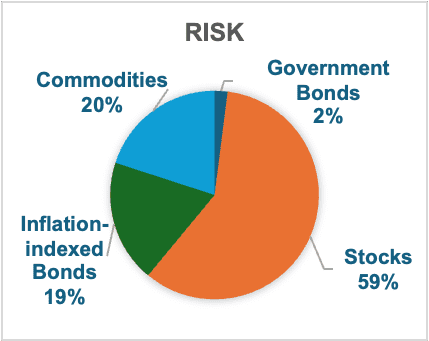
The result of the portfolio allocation shown above with respect to the risk in each of the four investment environments is displayed in Table 4 below. With a portfolio constructed like the Better-Balanced Portfolio, we spend very little time trying to determine when periods of rising economic growth might be ended by a recession and likely result in stocks performing poorly. The flip side of this means that we are also making less of a bet on stocks in periods of strong economic growth.
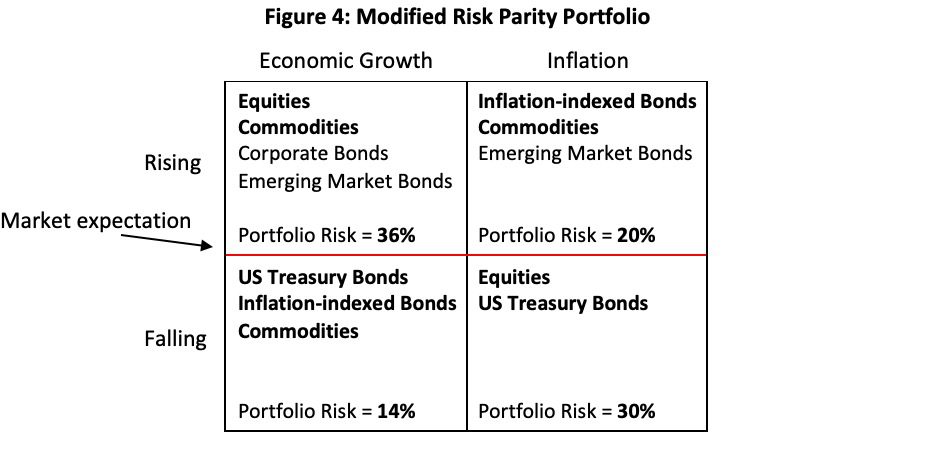
As a result, we expect the Better-Balanced Portfolio to underperform a 100% stock portfolio during periods of rising economic growth and falling inflation. However, we also expect the Better-Balanced Portfolio to perform better in periods of falling economic growth and rising inflation. Ultimately, the hope and expectation is that over long periods of time, the Better-Balanced Portfolio will likely perform better than a 100% stock portfolio and do so with less volatility. The baseball analogy is a 100% stock portfolio is trying to hit homeruns in two of the four investment environments, while the Better-Balanced Portfolio is trying to hit singles all the time.
Finally, the Better-Balanced Portfolio can be customized with any level of exposure to stocks designed to fit the specific financial needs and goals of each client. If you think this strategy could be right for you, or if you would like to learn more, please click the Let’s Talk button above and schedule an exploratory, no obligation meeting with us.
